

Flagship factory and scaling.
– supported by the EU Innovation Fund 2024.
PaperShell has signed a Grant Agreement under the EU Innovation Fund 2024 – one of Europe's most rigorous and competitive industrial climate programmes.
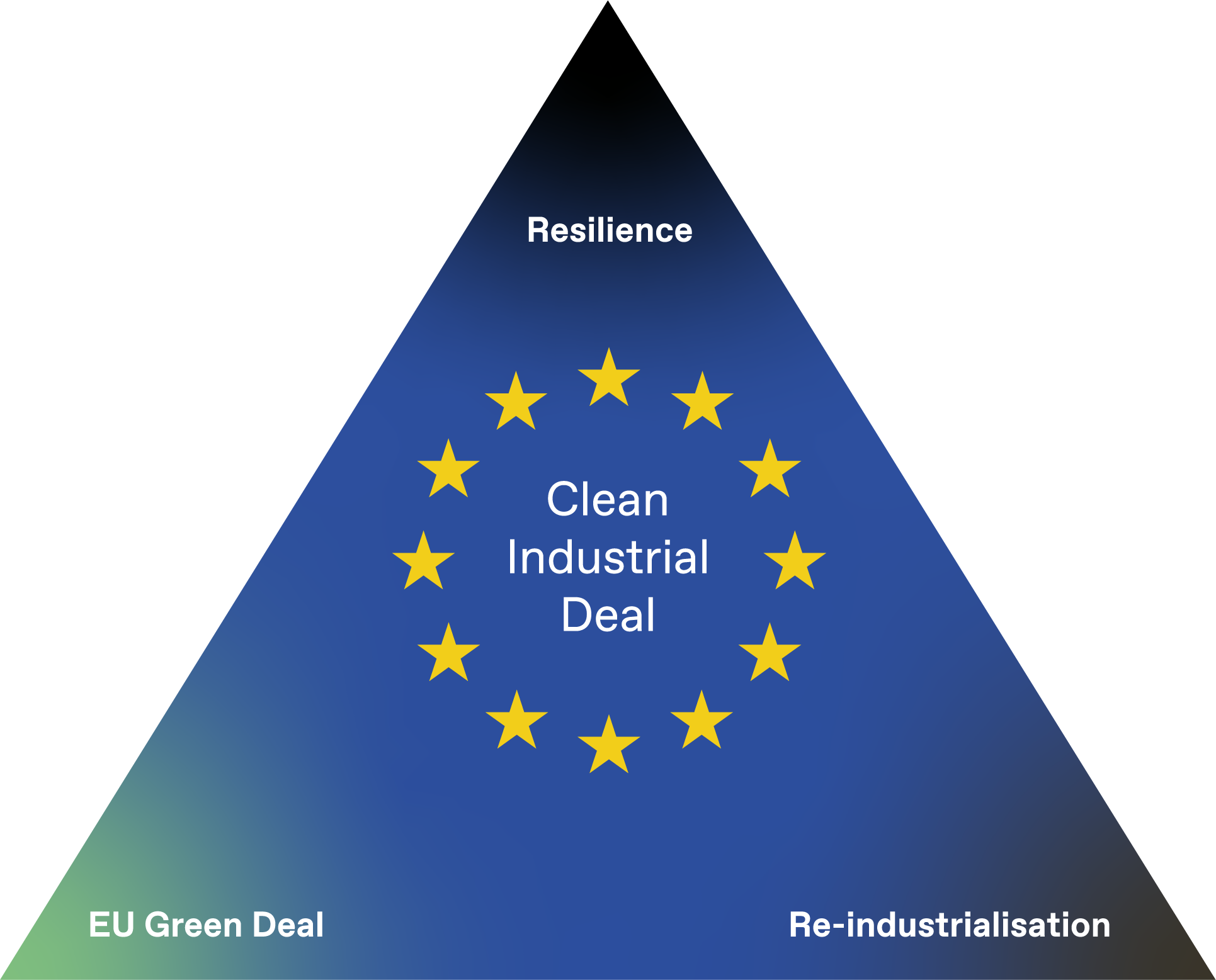
PaperShell’s Bio Material Scaling (BMS) project was selected as one of 61 projects out of 359 applications within the Net Zero Technologies – Medium Scale category, following an extensive evaluation and due diligence process covering climate impact, industrial maturity, financial robustness, replicability and operational readiness. In the evaluation, CINEA highlighted PaperShell’s strength in degree of innovation, replicability, and industrial leadership and competitiveness. The project positions the company as a key contributor to Europe’s Clean Industrial Deal – combining decarbonisation, reindustrialisation and resilience.
“Europe is entering a new industrial phase where resilience and decarbonisation go hand in hand. PaperShell is already producing fossil-free materials at industrial scale, and with this expansion we can meet growing demand from sectors like construction and defence. The factory in Tibro is not just increased capacity – it is proof that a new industrial production system is ready to scale.”
Anders Breitholtz, Founder and CEO

The project
PaperShell’s Bio Material Scaling project expands the existing factory in Tibro into a 15,600 m² flagship production facility. At full ramp-up, the facility will reach an installed production capacity of approximately 23,000 tonnes per year, producing fossil-free, load-bearing components that replace materials such as aluminium, plastics and glass fibre.
The system is built around a modular production architecture that enables high throughput, flexibility across applications, and future replication. Production is
designed for continuous operation and stable industrial performance, supporting large-scale deployment across construction, mobility, consumer goods and electronics. The factory is an Industry 4.0-ready replicable model for industrial deployment across Europe.
Why it matters
It strengthens European industrial capacity by establishing local, resilient production systems and reducing dependency on imported materials. At the same time, it supports the objectives of the EU Green Deal and Clean Industrial Deal by combining decarbonisation, reindustrialisation and long-term resilience.
By scaling a proven production system, the project demonstrates how industrial transformation can be achieved in practice — with measurable climate impact
and commercial viability. As CINEA noted in the Evaluation Summary Report, the project demonstrates “a significant contribution to Europe’s industrial leadership and competitiveness.
Circular system
Circularity is built into the production system from the outset. Production waste and end-of-life materials are converted into biochar through integrated pyrolysis – enabling permanent carbon storage and regenerative use in local ecosystems. The result is a closed-loop system where material flows are continuously reused and carbon is retained rather than released.
Knowledge sharing and replication
The flagship site in Tibro will function as a demonstration facility for industrial stakeholders, policymakers and the wider public – with open access to production insights, data and best practices to support further deployment across Europe.
Climate impact
- Absolute GHG emission avoidance: ~2.35 Mt CO₂e over 10 years.
- Relative GHG reduction: ~99.4% compared to fossil-based reference materials.
- Cost efficiency: ~€17 per tonne CO₂e avoided.
- Cost reduction: ~30% through automation and modular line design.
Core project deliverables
- GHG avoidance: 2,348,712 tCO₂eq over project lifetime.
- Industrial output: 31 million bio-based components/year at full capacity.
- Knowledge sharing: open-access replication framework for 5+ EU sites.
Key figures
- Total investment: €83.2 million.
- EU Innovation Fund support: up to €40.3 million.
- Production capacity: ~23,000 tonnes/year.
- CO₂e avoided (10 years): ~2.35 million tonnes.
- GHG reduction vs fossil-based materials: ~99.4%.
- Cost efficiency: ~€17 per tonne CO₂e avoided.
Timeline
- Project start: 1 April 2026.
- Construction start: 2027.
- Entry into Operation: January 2030.
- Project duration: 10 years (performance-based contract).
This project complies with the EU Innovation Fund communication and visibility requirements under Article 17 of the Grant Agreement. Updates are shared via PaperShell’s website and official LinkedIn and Instagram channels. Public signage and EU funding visibility will be implemented at the project site in accordance with EU requirements.