

Climate Impact Reduction
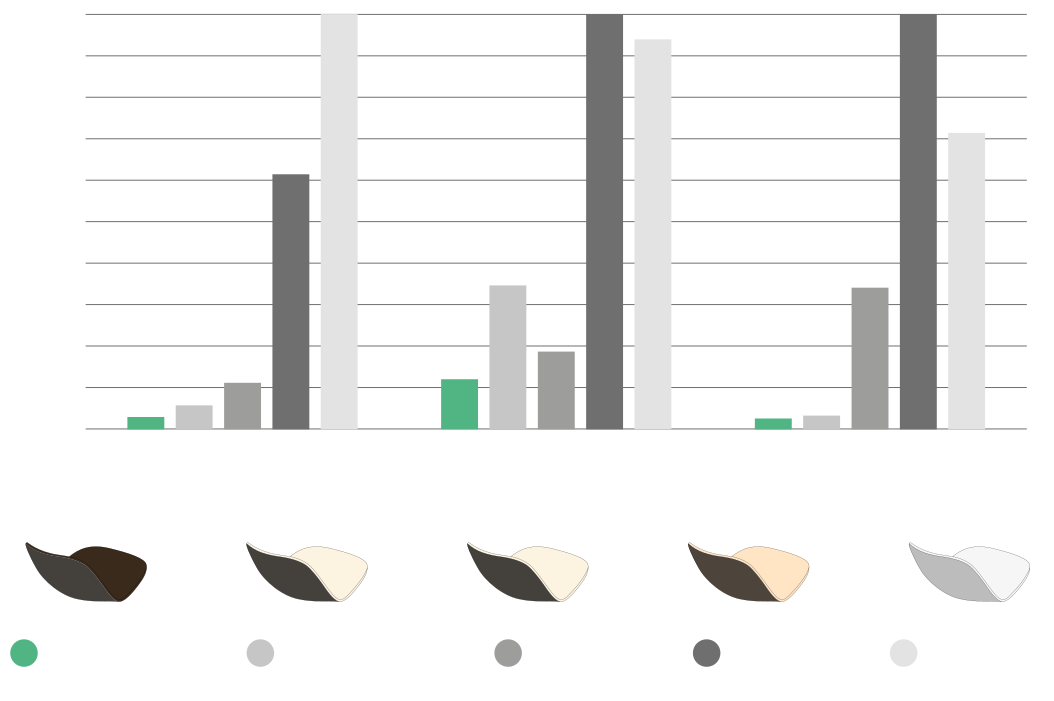
By switching materials in a new or existing products substantial environmental gains can be achieved fast and long before 2030. Below are examples of how the PaperShell material stands up to other materials and what replacement potential it has.
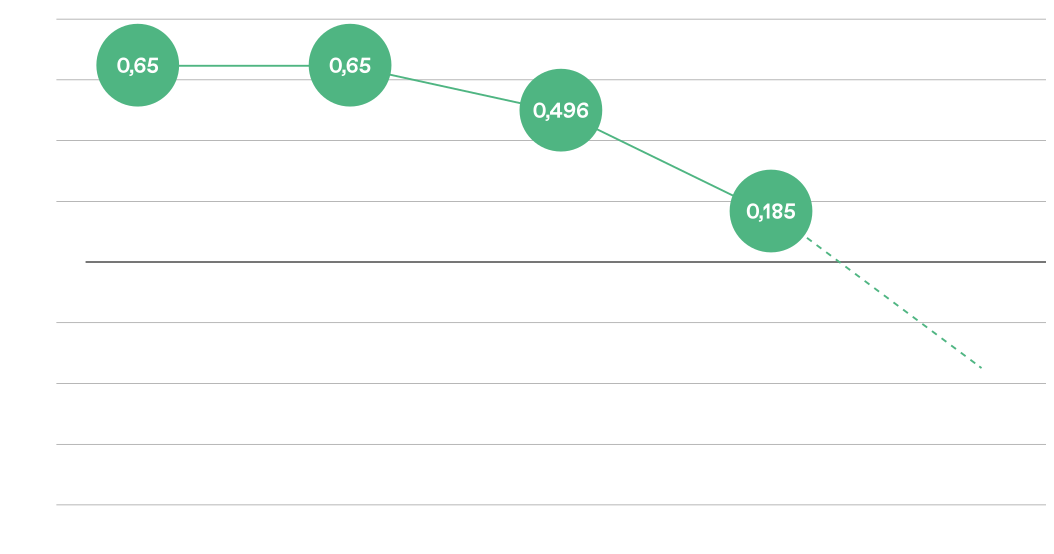
CO2e/kg ready made component

* 0,185 CO2e/kg, production waste to Biochar, calculated with LCA-partner.
Endpoint impact
As green house gases are just one dimension of planetary boundaries new materials needs to present efficient alternative for our entire ecosystem, in aspects such as land use, water use and resource depletion. At present, PaperShell’s total weighted single score per functional unit (EF3.0) vastly outperforms any other material in comparison, even components made of wood veneer.
Towards Net zero and beyond
PaperShell’s Life Cycle Assessment (LCA) evaluates the environmental impacts of our products across their entire life cycle, from raw material extraction to end of life. By constantly trimming our internal and external processes we keep pressing our overall climate impact towards net zero and beyond. With further utilisation of production waste to biochar and implementation of take-back systems for components end of life, PaperShell is on track of becoming Carbon negative long before 2030.
Material transition↓
Material transition↓
Material transition↓
Material transition↓
Material transition↓
By substituting materials known for high climate impact such as various types of fossil alternatives, PaperShell provides substantial CO2e reductions for every kg material replaced.
Wood (veneer)
50% CO2e reduction
Wood (veneer) refers to thin slices of wood usually thinner than 3 mm that typically are glued together or mounted onto panels to produce flat or single curved panels for furniture, doors, flooring, etc. Apart from fossil based glues pressed moulded veneer components are free of fossil based carbons.
Why use PaperShell? By switching to PaperShell you avoid adding 1,5 times as much CO2e into the atmosphere because the less need for resources, production efficiency is higher and the waste is lower. The source is EU (Scandinavia) and your product will still be sorted as wood. With higher design freedom (geometry, surface detail, etc). Much more moist resistant, flame retardant, and outdoor resilient.
Plastics (PP)
90% CO2e reduction
Polypropylene (PP) is one of the most common and classic “thermoplastics” that can be reheated and recycled again without significant degradation. Unfortunately, many plastics are contaminated with additives and flame retardants, lost and/or burnt, and only about 42% av all plastics in the EU are recycled. PP is recycled to a much lesser extent. Plastics like PP are 100% fossil based and will release their fossil carbon in the atmosphere end of life, regardless of how many times it is recycled.
Why use PaperShell? PaperShell has 0,00% fossil carbon inside. By switching to PaperShell you avoid adding 7,5 times as much CO2e into the atmosphere. There is no need for flame retardants and you are moving away from a fossil based resource. Unlike fossil based plastics PaperShell material will biodegrade in nature if lost.
Glass fibre (GFRP)
98% CO2e reduction
Glass fibre is a versatile material due to its lightweight, inherent strength, and weather resistance. Manufacturing of fibers uses large furnaces to melt silica sand, limestone, kaolin clay, fluorspar, colemanite, dolomite, and other minerals and is very energy intensive. The binders needed such as epoxy or PET resins are fossil based and hazardous flame retardants are frequently added. Recycling solutions for glass fiber reinforced thermoset composites (GFRP) are rare or non-existent in most regions.
Why use PaperShell? By switching to PaperShell you avoid adding nearly 40 times as much CO2e into the atmosphere, you don’t need flame retardants and your product will be sorted as wood.
Metal (Aluminium)
98% CO2e reduction
Aluminum is a strong and lightweight metal which is good for recycling. However, it requires a lot of energy to extract from Bauxite ore. To produce pure aluminum, 3 – 4 times more energy is required compared to producing iron. Huge amounts of both fossil fuel and electricity are used. The extraction is mostly in Australia, China, and South America. However, it takes 20 times less energy to recycle than to produce so keep this material in the loop!
Why use PaperShell? PaperShell has approximately half the strength but also half the weight, ie a component made of press moulded aluminium sheet of 1.5 mm weighs roughly the same as 3 mm PaperShell with the same strength. It will be cheaper and by switching to PaperShell you avoid adding 30 times as much CO2e into the atmosphere, you have a renewable and controlled resource from EU and your product will be sorted as wood.


PaperShell at UN Climate Summit COP28 in Dubai 2023. Milled PaperShell component equivalent to 1 kg CO2e, exhibited at Polestar’s material comparision clearly showing PaperShell’s potential.
Consultation regarding environmental permit for PaperShell’s expanded operations in Tibro
PaperShell AB (“PaperShell”) develops and produces moulded, fibre-based biomaterials. The company intends to apply for a permit pursuant to Chapter 9 of the Swedish Environmental Code for increased production at the company’s facility located within the properties Sekretären 4 (existing) and Sekretären 5 (additional) in Tibro.
Production will be expanded to a maximum of 17,500 m³ of finished product per year and will include, among other things, impregnation processes and the production of biochar. The operations are subject to a permit requirement and are also covered by the Industrial Emissions Ordinance (2013:250). Where necessary, the permit application will also include requests for the required exemptions.
Because the operations may be assumed to result in significant environmental impact, PaperShell invites the public and other stakeholders to participate in a scoping consultation in accordance with Chapter 6 of the Swedish Environmental Code. The purpose is to inform and obtain views on the location, scope and environmental effects of the operations, as well as on the content of the Environmental Impact Assessment (EIA) that will be prepared.
The main environmental effects are assessed to relate to noise, transport, energy consumption, emissions to air, accident risks, and impacts on natural values in connection with the development of the site.
A consultation document describing the plans is available here and can also be requested via samrad@geosyntec.com.
Participate in the consultation
Open consultation meeting
An open consultation meeting will be held on 14 April 2026 at 17:30 at Tibro Sporthall (conference room), address Gymnasiegatan 27, Tibro.
Please register your participation no later than 7 April using the contact details below.
Written comments
Written comments must be submitted no later than 30 April 2026.
Email: samrad@geosyntec.com
Post:
Geosyntec Consultants AB
Norra Hamngatan 6
411 14 Gothenburg, Sweden
Please mark your submission “Consultation PaperShell”.
Information on how we process your personal data and on your rights can be downloaded here.
How much can you reduce your climate impact?
Contact Us
For inquiries or booking appointments, please fill in the form below.
"*" indicates required fields